

Short answer: the UAE is replacing PDF and paper invoices between businesses with structured electronic invoices that pass through government-approved service providers and are reported to the Federal Tax Authority (FTA). Large businesses (revenue of AED 50 million or more) must be live by 1 January 2027; everyone else by 1 July 2027. The first hard deadline, appointing an Accredited Service Provider if you are a large business, is 30 October 2026.
If you run a trading, distribution or service business in the UAE, this will change how every B2B invoice leaves your company. The good news: if you start now, it is very manageable. This guide explains what is changing, the dates that matter, and a practical plan to get ready, without the jargon.
This guide is general information, not tax or legal advice. Rules can change, so always confirm details with the UAE Ministry of Finance and the FTA, or your tax adviser.
What is changing (in one minute)
Today, most UAE businesses create an invoice in their accounting software, save it as a PDF and email it to the customer. Under the new system, that stops counting as a valid invoice for in-scope transactions.
Instead:
- Your system creates the invoice as structured data (a machine-readable XML file in a UAE format called PINT AE, based on the international Peppol standard).
- It sends that data to your Accredited Service Provider (ASP), a company approved by the Ministry of Finance.
- Your ASP checks it and forwards it to your customer’s ASP, which delivers it into your customer’s system.
- The tax data is reported to the FTA along the way.
As tax specialists at Hawksford put it, invoices sent as PDFs, Word documents, scanned copies, images or emails “will not be treated as e-invoices.” (Hawksford)
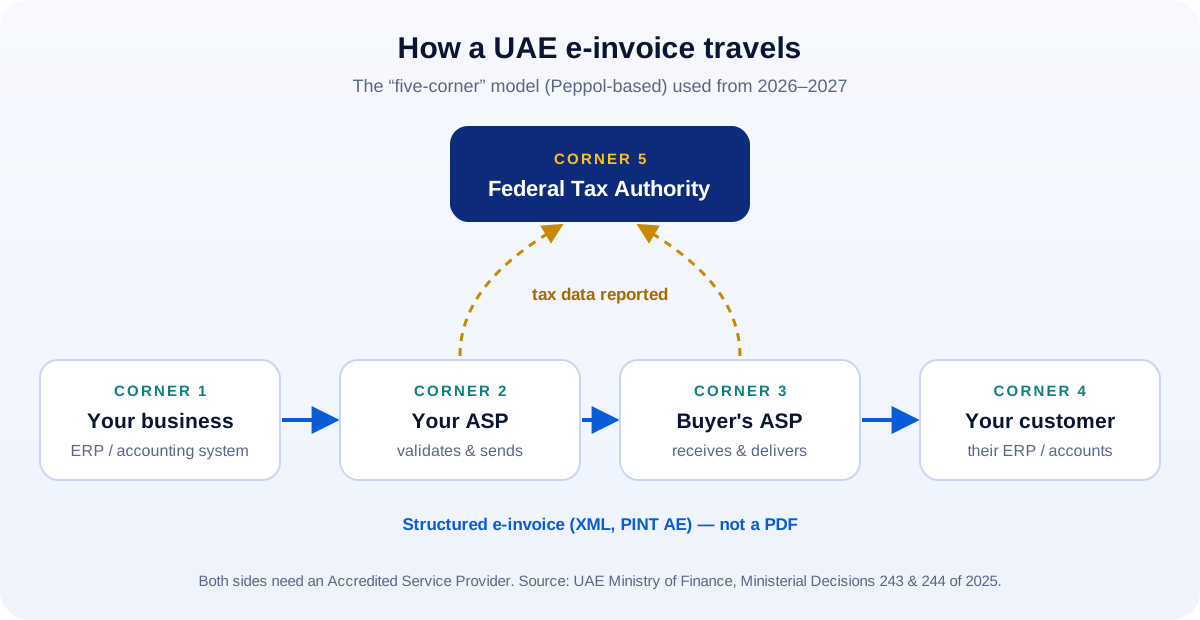
This is called a five-corner model: you, your ASP, your customer’s ASP, your customer, and the FTA as the fifth corner. The system is set out in Ministerial Decisions No. 243 and No. 244 of 2025. (KPMG UAE)
The key dates for 2026 and 2027
| Who | Appoint an ASP by | E-invoicing mandatory from |
|---|---|---|
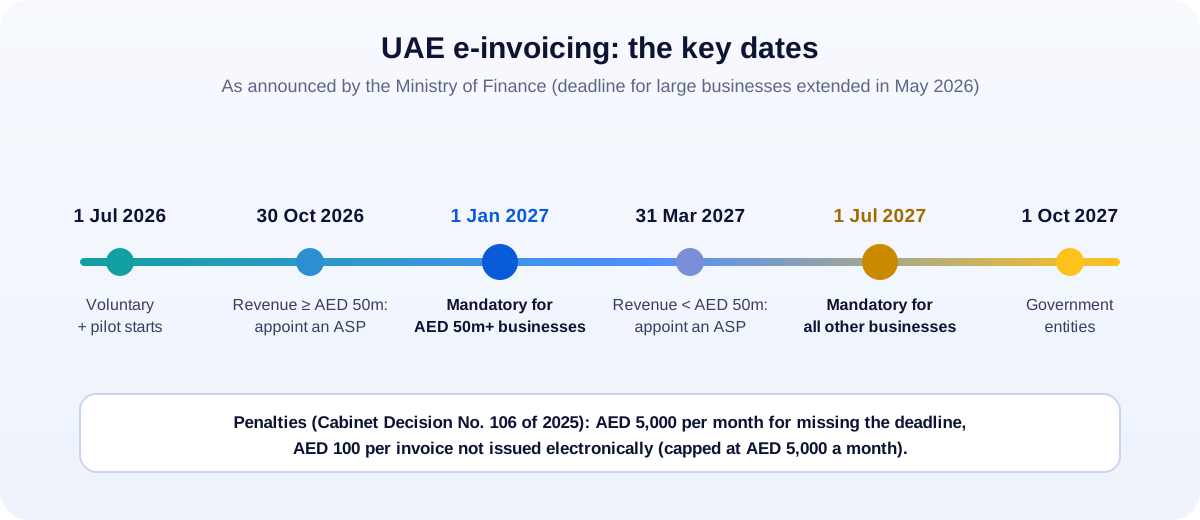
| Any business (voluntary) | Any time | 1 July 2026 |
| Annual revenue AED 50 million or more | 30 October 2026 | 1 January 2027 |
| Annual revenue below AED 50 million | 31 March 2027 | 1 July 2027 |
| Government entities | 31 March 2027 | 1 October 2027 |
One date moved this year. In May 2026 the Ministry of Finance extended the ASP appointment deadline for large businesses from 31 July 2026 to 30 October 2026, but kept the go-live date: those businesses must “fully implement the eInvoicing system by no later than 1 January 2027.” The Ministry also said 32 service providers had already been approved, with more in the final stages. (UAE Ministry of Finance, 10 May 2026)
What this means for SMEs: even if your revenue is below AED 50 million, your large customers will be sending and expecting e-invoices from January 2027. Suppliers who are ready early will be easier to work with, and easier to keep.
Who is in scope, and who is not
According to KPMG’s summary of the decisions, the system applies to every business in the UAE that makes business-to-business (B2B) or business-to-government (B2G) transactions.
For now, these are excluded:
- Business-to-consumer (B2C) sales, such as retail sales to the public.
- Certain government sovereign activities.
- International passenger air transport and some international goods transport (a temporary exemption).
- Certain VAT-exempt or zero-rated financial services.
Both sides of an in-scope sale need an ASP: the Ministerial Decisions require that “both issuers and recipients of electronic invoices and electronic credit notes must appoint an ASP.” So even a business that mostly buys (and rarely sells B2B) still needs to be able to receive e-invoices.
What an Accredited Service Provider (ASP) actually does
Think of an ASP as a secure post office for invoices. It:
- Validates your invoice against the UAE rules (for example, that required fields such as tax registration numbers and VAT amounts are present and correct).
- Transmits it to your customer’s ASP over the Peppol network.
- Reports the required tax data to the FTA.
- Receives e-invoices sent to you by your suppliers and delivers them into your system.
What an ASP does not do is fix bad data. Your business stays responsible for the accuracy and completeness of every invoice. If your customer records are missing TRNs, or your item names and VAT codes are inconsistent, the invoice will be rejected, and that is where most of the real work lies.
The UAE format is detailed. Avalara, one of the major tax technology providers, notes the regime requires 51 mandatory data fields for a standard tax invoice under PINT AE. (Avalara) Most of these fields already exist in a good accounting system; the question is whether yours are filled in correctly every time.
The penalties
Penalties are set by Cabinet Decision No. 106 of 2025, as reported by Khaleej Times and tax advisers:
- AED 5,000 per month for failing to implement the system or appoint an ASP by your deadline.
- AED 100 per invoice or credit note not issued electronically, capped at AED 5,000 per month.
- AED 1,000 per day for not notifying the FTA in time about a system failure that stops you issuing e-invoices, or for not updating your ASP about changes to your registration details.
Businesses that join voluntarily before their deadline are not penalised during that voluntary period, which is one more reason to start early.
A 7-step plan to get ready
This is the order we recommend. It keeps the expensive decisions until you know exactly what you need.
1. Work out your phase and your real deadline
Check your annual revenue against the AED 50 million threshold. Then list your largest customers: if any of them are large businesses, assume they will want e-invoices from you from January 2027, whatever your own phase.
2. Map how invoices are created today
Write down every place an invoice is born: your ERP or accounting software, a separate POS, an Excel template, a branch office that invoices by hand. Each of these must produce structured data in the end. Hand-made Excel invoices are the most common problem.
3. Clean your master data
This is the step that decides whether go-live is smooth or painful:
- Customers: legal name, address and TRN for every VAT-registered customer.
- Items and services: consistent names, units and VAT treatment.
- Suppliers: you will receive their e-invoices, so match them to your supplier records.
4. Check whether your system can connect to an ASP
Ask your software vendor three questions: Does it produce PINT AE invoices or a format the ASP can convert? Does it integrate with ASPs (and which ones)? Can it receive incoming e-invoices and credit notes? If the answers are vague, plan for an integration or an upgrade.
5. Shortlist and appoint an ASP
Use the Ministry of Finance’s list of approved providers. Compare them on integration with your system, pricing (per invoice or per year), support in your time zone and language, and how they handle rejected invoices. Large businesses must appoint by 30 October 2026; others by 31 March 2027.
6. Test with real invoices
Run a pilot: send test invoices for your most common transaction types (standard sale, credit note, zero-rated export, a customer with multiple branches). Fix every rejection at the source, in your master data or system settings, not by editing invoices by hand.
7. Train the team and set a routine
Your sales and accounts teams need to know what changes: no more “just send the PDF”, credit notes must go through the system, and rejected invoices need someone assigned to fix them the same day.
Where businesses usually get stuck
In trading and distribution companies, the hard part is rarely the technology itself. The usual sticking points are:
- Invoices created outside the main system (Excel, handwritten, branch-level workarounds).
- Incomplete customer data, especially missing or wrong TRNs.
- Old or heavily customised accounting software with no clean way to connect to an ASP.
- Nobody owning the project until a customer or the FTA forces the issue.
If this sounds familiar, e-invoicing is a good moment to fix the underlying problem: one system where every sale, invoice and stock movement lives, instead of five spreadsheets that someone reconciles every month-end. We wrote about the warning signs in signs your trading business has outgrown Excel.
How UMA can help
To be clear about our role: UMA is not an Accredited Service Provider. We are a technology and marketing agency. What we do is the work around the ASP:
- Map your current invoicing flow and clean up your customer and item data.
- Build or upgrade the business system that creates your invoices (inventory, sales and invoicing in one place) so it can connect to the ASP you choose. See our app and software development service.
- Build dashboards so you can see sales, VAT and rejected invoices at a glance (data analytics and reporting).
If you would like a straight answer on how ready your business is, send us a message with your system name and roughly how many invoices you issue a month. We will tell you honestly what needs to change, even if the answer is “very little”.
Sources
- UAE Ministry of Finance: Targeted amendments to eInvoicing system decisions (10 May 2026)
- KPMG UAE: Implementation of the electronic invoicing system in the UAE
- Hawksford: UAE e-invoicing: timeline, business actions and penalties
- Avalara: UAE e-invoicing mandate 2026: readiness, ASP and PINT AE
- Khaleej Times: Penalties announced for violating e-invoicing regulations