

Short answer: AI answers from Google (AI Overviews and AI Mode), ChatGPT, Perplexity and Copilot now sit between your customers and your website. To be cited in them, your site has to be easy to crawl, easy to understand, and the clearest, most trustworthy answer to the questions your customers actually ask. That is mostly good SEO done properly, with a few specific additions. Nobody can guarantee an AI will mention you, but you can make it far more likely.
Why this matters now
This is no longer a future trend. At Google I/O in May 2026, Google said AI Overviews has over 2.5 billion monthly active users, and AI Mode, its chat-style search, “has already surpassed 1 billion monthly active users” in its first year. (Google, I/O 2026 keynote)
For a business, that changes the first impression. When someone in Lahore, Dubai or Riyadh asks “who is a good accountant for a small trading company near me?”, the first thing they may read is an AI summary. The businesses named or linked in that summary get the attention.
First, the good news: it’s still SEO
There is a lot of noise about “GEO” (generative engine optimization) and “AEO” (answer engine optimization), and a lot of people selling it. Google’s own guidance is refreshingly direct:
“From Google Search’s perspective, optimizing for generative AI search is optimizing for the search experience, and thus still SEO.” — Google Search Central
Google also says its AI features are “rooted in our core Search ranking and quality systems,” and that “there are no additional requirements to appear in AI Overviews or AI Mode, nor other special optimizations necessary.” (Google Search Central: AI features and your website)
So if you have been putting off SEO, you have not missed a separate train. The same work helps you in both places.
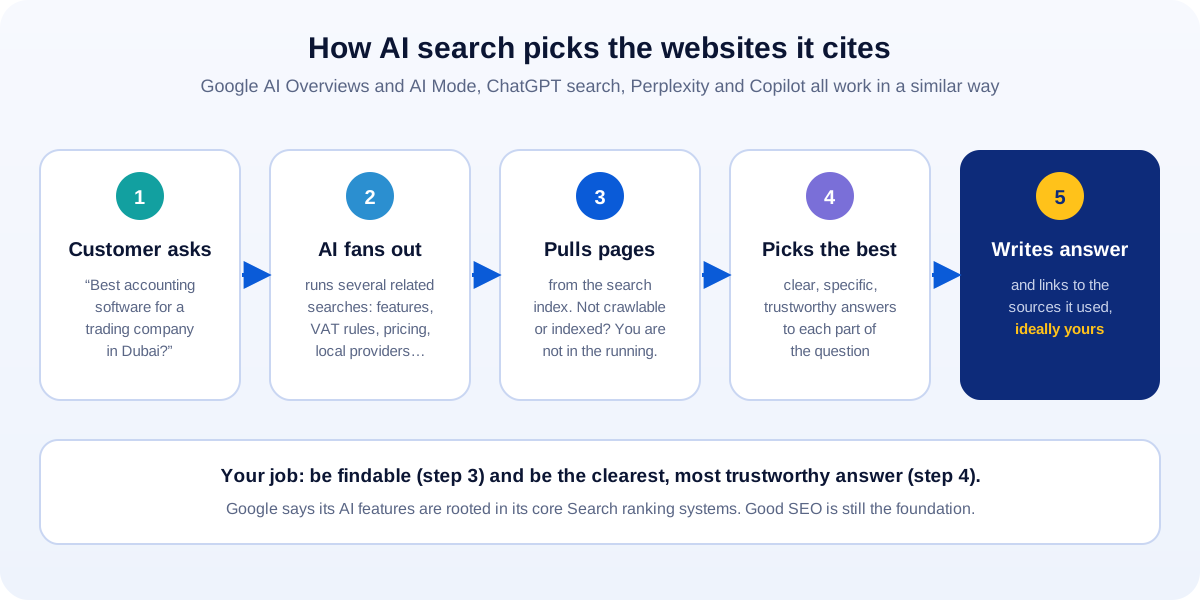
How AI search decides which sites to cite
Google describes a process called query fan-out: “a set of concurrent, related queries generated by the model to request more information and fetch additional relevant search results.” In plain terms, one customer question becomes several searches behind the scenes (features, prices, rules, local options) and the AI pulls pages that answer each part.
That gives you two jobs:
- Be findable: your pages must be crawlable and indexed, or you are not even considered.
- Be the best answer to a part of the question: clear, specific, accurate and trustworthy.
The 10-step checklist
1. Make sure the AI crawlers can reach you
- Google: check that important pages are indexed in Google Search Console (use URL Inspection).
- ChatGPT: OpenAI says its search crawler is OAI-SearchBot, and sites that block it “will not be shown in ChatGPT search answers.” (OpenAI) Allow it in your
robots.txt. - Microsoft Copilot: it draws on Bing, so add your site to Bing Webmaster Tools and submit your sitemap.
- Your firewall or CDN: security settings that block “bots” can accidentally block search crawlers too. Test with the live test in Search Console.
2. Answer the question in the first two sentences
AI systems (and busy humans) look for the direct answer. Start key pages and articles with a short, plain answer, then explain. Every guide on this blog starts with a Short answer for exactly this reason.
3. Write what only you can write
Google warns: “Don’t just recycle what others on the internet have already said, or could easily be produced by a generative AI model.” The content that gets cited offers something new: your prices and process explained honestly, real examples from your market, local rules, common mistakes you see customers make, and clear opinions.
A page titled “Benefits of SEO” competes with a million identical pages. A page explaining what SEO actually costs a clinic in Rawalpindi and how long it takes to see results has far fewer rivals.
4. Cover the follow-up questions
Because of query fan-out, the AI will also search for the next questions a customer might ask. Add them to the page: cost, timeline, requirements, alternatives, and “is it right for me?”. A short FAQ section at the end of a page is an easy way to do this.
5. Keep important information in text, not images
Google asks site owners to make sure “important content is available in textual form.” Prices, opening hours, service areas and contact details in a JPEG flyer are invisible to most AI systems. Put them in the page text.
6. Fix your Google Business Profile
Google says Business Profile “can help your products and services to be visible in both AI responses and other Google Search results.” Complete every section: categories, services, hours, service areas, photos and a description written for customers. Keep your name, address and phone number exactly the same on your website, profile and directory listings.
7. Use structured data, accurately
Google is clear that “structured data isn’t required for generative AI search, and there’s no special schema.org markup you need to add.” But standard structured data still helps search engines understand you (Organization, LocalBusiness, Article, FAQ), as long as it matches the visible text on the page. Never mark up content that visitors cannot see.
8. Earn mentions on other trusted sites
AI answers often lean on what other sites say about you: reviews, directories, local news, industry associations and partners. A steady flow of genuine Google reviews, listings on respected directories in your country, and the occasional guest article or interview all build that picture.
9. Make the site fast and easy to use
Google lists “providing a great page experience” among its recommendations. A slow, confusing site loses both human visitors and ranking signals. Check your pages in PageSpeed Insights, especially on mobile.
10. Measure what is happening
- Google: traffic from AI features is counted in Search Console’s Performance report under the Web search type, according to Google.
- ChatGPT, Perplexity and others: look for referral traffic from
chatgpt.com,perplexity.aiandcopilot.microsoft.comin your analytics. - Spot checks: once a month, ask the AI tools the questions your customers ask and note who gets mentioned.
What not to spend money on
- “Guaranteed AI mentions”. Nobody controls what an AI writes. Anyone promising guaranteed placement in ChatGPT or Google’s AI answers is overselling.
- Special AI files for Google. Google says “you don’t need to create new machine readable files, AI text files, markup, or Markdown to appear in Google Search.” (Other AI companies may use such files in future, but they are not a shortcut to rankings today.)
- Mass AI-written articles. Thin, recycled content is exactly what Google says not to publish, and it will not earn trust from people or machines.
A realistic timeline
For a small or medium business starting from a basic website:
- Weeks 1–2: technical fixes (crawling, indexing, speed), Google Business Profile, consistent contact details.
- Months 1–3: rewrite your key service pages with direct answers and FAQs; publish a few genuinely useful guides for your market.
- Months 3–6: reviews, directory listings and mentions build up; you start seeing which questions bring AI and search traffic, and you double down on those.
How UMA can help
This is our everyday work: SEO that covers both classic search and AI answers, content and copywriting that answers real customer questions, and fast, well-structured websites that search engines can read.
We practise what we recommend. This website is built to load fast, its robots.txt welcomes Google, Bing and ChatGPT’s crawlers, and it uses accurate structured data. If you would like to know how visible your business is in AI answers today, send us your website address and the questions your customers ask most. We will check where you stand and tell you the first three things to fix.
Sources
- Google: Google I/O 2026 keynote (19 May 2026)
- Google Search Central: Optimizing for generative AI features on Google Search
- Google Search Central: AI features and your website
- OpenAI: Overview of OpenAI crawlers